About
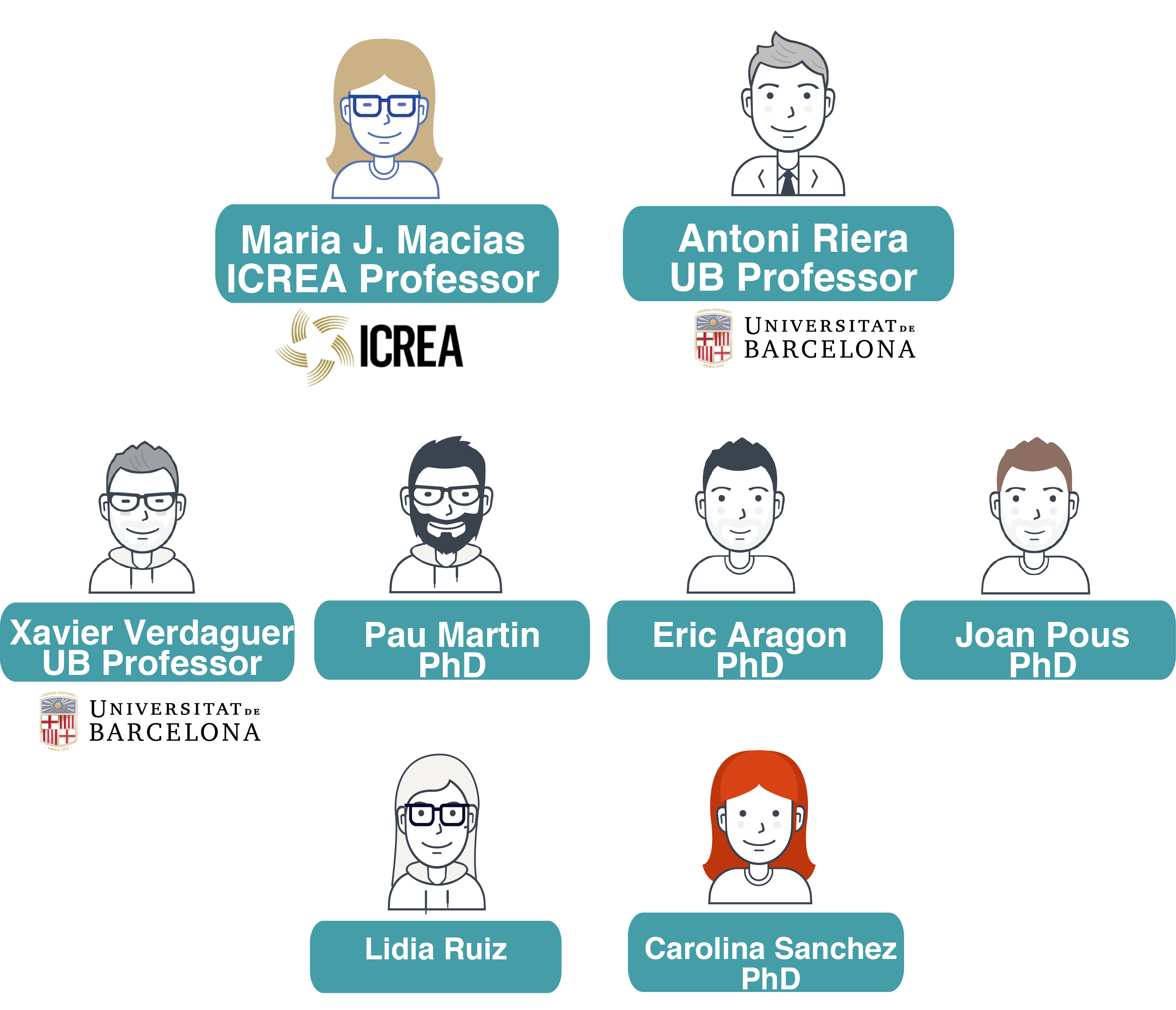
SINESBIO is constituted as an SGR group in 2010. Since the beginning, we have had the idea of a multidisciplinary research group with complementary expertise, to generate cutting-edge knowledge at the interface of biomedicine and chemistry, structural and molecular biology.
The core team consists of two Group Leaders of the IRB Barcelona, Prof. Antoni Riera, who is a full professor of Organic Chemistry at the Universitat de Barcelona, and Maria J. Macias, an ICREA research professor in structural biology since 2002, who is the coordinator of this group since 2022. Together we combine the expertise in Organic Chemistry, X-ray, NMR, SAXS, artificial intelligence and informatics, as well as molecular and cell biology, which are the essential pillars of knowledge required to carry out our research.
The core team is also composed of four experienced researchers, (Dr. E. Aragón, Dr. P. Martin, Dr. J. Pous and Dr. X. Verdaguer) and two highly-experienced research assistants (L. Ruiz and C. Sánchez). Dr. Eric Aragon and Lidia Ruiz both have a background in Biology and Biochemistry and a solid knowledge of molecular and cellular biology. Dr. Pau Martin has a solid knowledge of NMR, programming and bioinformatics. Dr. Joan Pous is an experienced crystallographer and Dr. Xavier Verdaguer is an Organic Chemistry professor at the UB. Carolina Sánchez is an experienced chemist.
Research topics
The main areas of our research are the following:
- TGFβ signaling pathway shapes animal development and differentiation, but that is often also at the core of several life-threatening diseases. We aim to identify molecules that can target this pathway in cancer and rare diseases.
- We apply and develop novel methodologies to speed up the determination of protein structures and complexes to decipher the molecular basis of TGFβ signaling.
- We develop novel synthetic methods and reactions to unlock access to previously unattainable -but biologically relevant- molecules. Part of our research is focused on deciphering new mechanisms and technologies to tailor the degradation machinery of cells to target specific proteins affected in severe diseases. These proteins include the p38𝛼 mitogen-activated protein kinases (p38𝛼), a protein that plays critical roles in cellular responses, proliferation, survival, cell cycle, and migration in cancer and several transcription factors mutated in cancer.
- We also study the conformations in solution of peptide hormones that regulate the endocrine system, affect neurotransmission processes and cell proliferation. Our aim is to employ the structural knowledge to improve their stability and functionality and to obtain analogues with pharmacological applications.
- Recently, together with medical doctors and researchers of the Sant Pau hospital in Barcelona, we have started to study the probability of relapse and metastasis of gynecological Cancer patients to empower the doctors with new affordable diagnostic tools to provide the best possible care to these patients. The project is based on the analysis of genomic and transcriptomic data retrieved from biopsies using artificial intelligence.
Highlights
- Defined phosphorylation-dependent mechanism of TGFβ signaling that labels SMAD proteins, first for activation and then for degradation (Cell 2009, Mol. Cell 2009, Genes and Dev, 2011). Identified novel DNA motifs for SMAD proteins (Nature Communications, 2017).
- Determined the molecular basis for distinct roles of SMAD2 and SMAD3 in the regulation of progenitor differentiation genes (Genes and Dev, 2019).
- Elucidated the rules that define the different composition of SMAD complexes in BMP and TGFβ pathways and Characterized the Conformational landscape of full-length non-activated SMAD proteins (Computational and Structural Biotechnology Journal 2021).
- Elucidated how TGFβ drives immune evasion in genetically reconstituted colon cancer metastasis (Nature 2018).
- Synthesis of peptide analogues with therapeutic properties (ChemBioChem 2011, Angewandte Chemie 2012, Scientific reports 2016, Nature Communications, 2021).
- Synthetic methodology: Pauson-Khand reactions, asymmetric hydrogenation, new chiral ligands
- Synthesis of biologically active compounds (amino acids, aza-sugars)
Acknowledgements